
You’re interviewing Backwards
Interviews are recruiting, not screening.

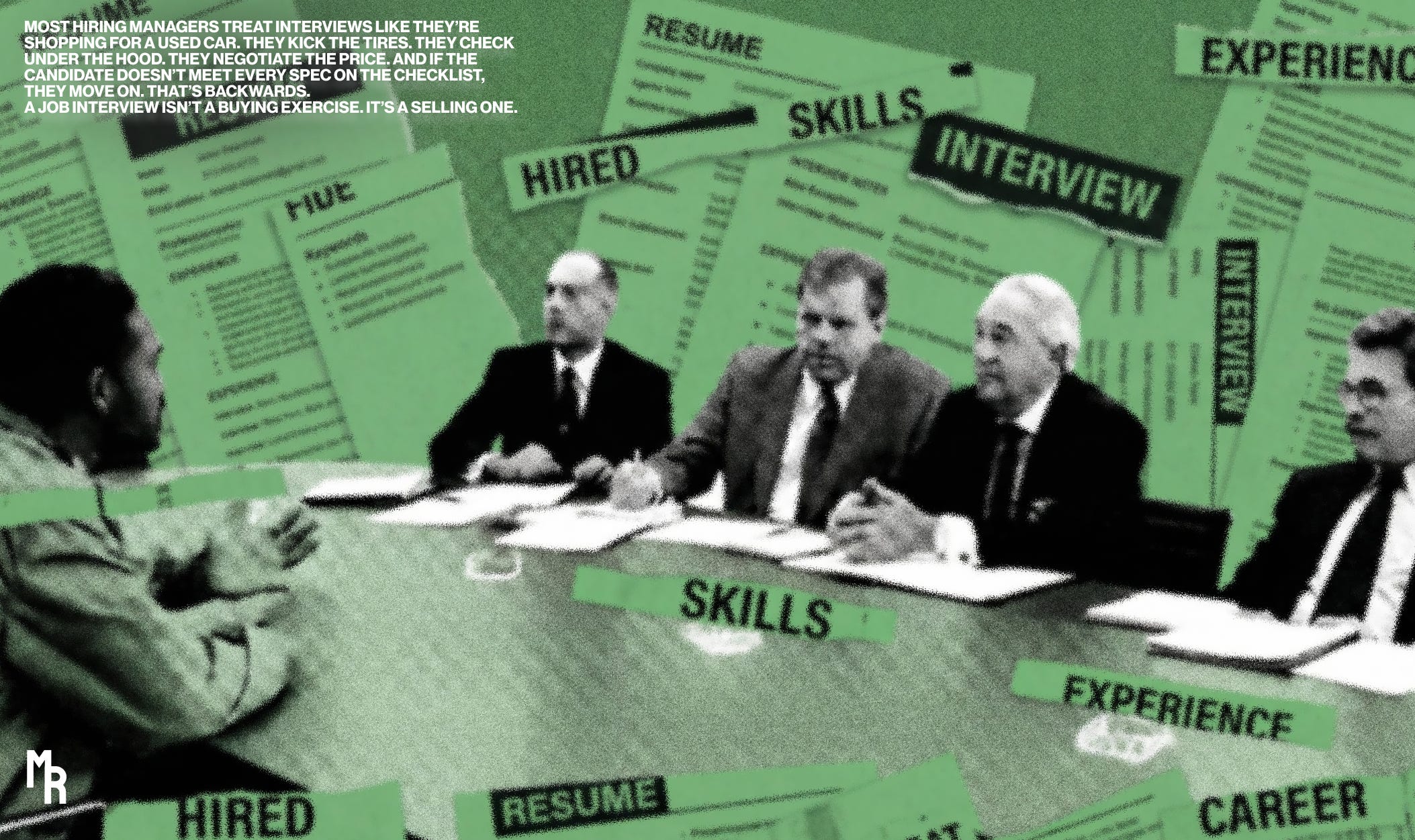
Most hiring managers treat interviews like they’re shopping for a used car.
They kick the tires. They check under the hood. They negotiate the price. And if the candidate doesn’t meet every spec on the checklist, they move on.
That’s backwards.
A job interview isn’t a buying exercise. It’s a selling one.
The Alumni Interview That Changed Everything
A friend of mine does alumni interviews for one of those highly selective schools that rejects brilliant kids by the thousands. He’d meet these incredible young people. Smart. Poised. Accomplished. He’d write glowing recommendations.
And then most of them wouldn’t get in.
At first, he was frustrated. What was the point?
Then it hit him: the school didn’t need his help spotting great candidates. They had more than enough of those. What they needed was help landing the great candidates who got accepted.
These kids were applying to dozens of schools and getting in to many of them. The real question wasn’t “Should we let them in?” It was “How do we convince them to choose us?”
My friend flipped the script. He stopped acting like a buyer and started acting like a seller. He used those interviews to talk up the school, to paint a picture of what made it special, to give candidates a reason to say yes when the acceptance letter arrived.
Smart, right?
Now ask yourself: When was the last time you approached a job interview that way?
The Netflix Rule Nobody Wanted
At Netflix, I had a rule that drove people crazy at first: I simply insisted that every person who came in for an interview should leave dying to work at Netflix. Even if it was obvious in the first five minutes that we weren’t going to hire them.
Why waste time on someone you’re never going to make an offer to? Three reasons:
First, because that “wrong candidate” is going to tell everyone they know about their interview. I’d much rather have them saying “Netflix was amazing, I wish I’d been the right fit” than “They were dismissive and rude.”
Second, the best candidates are always talking to multiple companies. If you act like they should be grateful just to sit in your lobby, they’re going to accept the offer from the place that made them feel wanted.
Third—and this one might surprise you—you’re not always right. Sometimes that person you dismiss in the first five minutes would have been perfect for a different role. Or they’ll grow into an incredible fit three years from now. But you’ve already burned that bridge.
The Master Class: Exit Interviews
Want to know the real test of this philosophy? Try applying it to exit interviews.
I know, I know. Why on earth would you “sell” your company to someone you’re letting go?
Because—and I’ve seen this happen more times than I can count—if you treat people with respect and kindness when you’re parting ways, they can actually leave with positive feelings about how they were treated. Not about losing their job, obviously. But about how the company handled it. About your behavior.
And they talk too. To potential candidates. To potential customers. To potential investors.
You have no idea which of those future conversations will matter. Why gamble that this wasn’t one of them?
What This Really Means
I’m not suggesting you turn every interview into a cheesy sales pitch.
The point is recognizing what an interview really is: a chance to create goodwill for your company.
Every interaction nudges your reputation up or down. In a world where a single Glassdoor review or LinkedIn post can reach thousands of people instantly, that reputation is a real asset—or a real liability.
But the fun part: it actually makes you a better interviewer.
When you’re trying to sell the opportunity, you have to articulate what makes your company special. Why this role is exciting. What problems this person will get to solve. You’re painting a picture of possibilities, not just ticking off requirements.
And that’s when you learn the most about a candidate. Not when you’re grilling them about their résumé, but when you’re in a real conversation about what you’re both looking for.
It’s Not Complicated
The best candidates have options. They always have. They always will.
The question isn’t whether they’re good enough for you. The question is whether you can convince them that you’re good enough for them.
So the next time you’re sitting across from a candidate, ask yourself:
Am I interrogating or conversing?
Am I evaluating or engaging?
Am I buying—or selling?
Because if you’re still approaching interviews like a buying exercise, I guarantee your competitors are approaching them differently.
And they’re hiring the people you’re letting walk out the door.
Hey Marc. Always enjoy and appreciate your perspective. Some personal experiences on interviewing that might amuse/interest you. I started my beard the day I left the Army in 1969. After seven successful years at my first company, I decided to move on. Although I landed in a good spot, there were a couple speed bumps. The head of Siemens medical division in the U.S. rejected me outright because I had a beard despite strong recommendations from the executive who would have been my boss. The president of a mid-size company he had founded, would not even interview me when he saw my beard. More in line with your guidance, the best hire I ever made, took a lot of selling on my part. I needed a product manager for a very innovative and promising electronic cardiac instrument. My hiring criteria were classic cookie cutter stuff: technical undergraduate degree, successful experience in field sales and an MBA. I met the person I eventually hired in a non-recruiting setting. He had undergraduate and advanced degrees in public health administration. He had put himself through school, working as a Los Angeles County Fire Paramedic. I convinced him to join the commercial sector because he could have more impact on mankind by moving across the country and marketing our cardiac products. He was there long after I left and went on to be president of a leading competitor.
It’s so true the exit interview is so important! I left a job once because I was moving states, and my manager at the time made an unethical move to try and cut my compensation before I left. I was so hurt and it tarnished what was otherwise a positive relationship. I was let go of another job and my leadership time up to my SVP called me after and encouraged me, even helping me to set up interviews. They often have people follow them to different companies and if I went back to sales, I’d work with them in a heartbeat. Arguably my time at the first job was smoother, but how people treated me when I left made a strong impression. As someone who works for myself now as a writing coach, I’m going to try and apply this to my own conversations.